Today
I had a long day yesterday. I drove to Leamington Spa and back for the purposes of an English Concert Singers rehearsal. We're all off on a concert visit to Salzburg at the end of next month and there were a lot of new pieces to sing and our conductor Roy had to weld us into some kind of ensemble.
We meet irregularly, usually for a few Sunday rehearsals, before a big concert. Yesterday there were about seventy of us.
The members of this group also permeate the English Concert Chorus which provides the vocal element to a range of classical "pop" concerts in London and Birmingham and also the British Choral Institute which offers various choral workshops during the year. People travel from all over the country, although there are clusters from Essex, the Midlands and Sussex, probably reflecting places where Roy has lived and worked.
So how I did come to be involved?
In My Day
At one time, back in the 1990s I was secretary to my local choir. This entailed, among other things, receiving large quantities of junk mail relating to musical events all over the country. In 1994 I was all prepared for a week away covering for the regular choir at Exeter Cathedral. I'd done this the year before at Gloucester and had a splendid time. So I was very disappointed when the Exeter event was abruptly cancelled.
There I was, all dressed up with nowhere to go, so to speak. I disconsolately leafed through the junk mail and noticed a flyer for a choral study week at a very posh girls' school near St Albans in Hertfordshire. There were chamber choirs, opportunities to learn singing in foreign languages and advice on choir administration. I called and was told that there was a place left. I booked and went off, entirely alone and not knowing a soul.
This event was run by the British Choral Institute, director Roy Wales. He had gathered around him a creme de la creme group of conductors and vocal trainers. It was clear that Roy had a passion for choral singing. His wife Chris did all the administration and smoothed many paths and ironed out all difficulties. The sun shone all week and I had a lovely time. We all sang together every night (I've never known the reason why Roy chose a requiem each evening...) and gave our closing concert in St Martin-in-the-Fields. I went home feeling refreshed.
After that, I contacted Roy to see if he would do a vocal techniques day for our choir, this he did, staying overnight at our place.
I soon discovered that, once on Chris' mailing list, you were never off it and my next adventure with BCI was the first Alfriston Choral weekend where about ninety of us sang Israel in Egypt with a string orchestra, entirely filling the little church. I found that people whom I'd last seen in Hertfordshire greeted me like an old friend. So I kept on going year after year. The events gave me an opportunity to sing the "big" works which were unsuitable for my smaller choir.
Chris Wales never missed any opportunity to advertise other events and I soon became aware of ECC events. In 2004 off I went to sing in "The Glory of Christmas" at the Barbican and Symphony Hall, Birmingham. While I wouldn't call these cultural high points, they were great fun and I began to cement a few friendships.
Finally I was allowed into the hallowed inner circle of the ECS. I've sung with them in Dubrovnik, Yarm, Peterborough, Leamington Spa and Birmingham, to name a few places and the repertoire has been wide and quite different from that of either Laetare or Cantilena. I never cease to be fascinated by Roy's passion and energy and amazed to the point of intimidation by Chris's efficiency. And I'm really looking forward to Salzburg.
All of which makes a mere five hours' drive and another five singing seem a mere trifle compared to the rewards.
Monday, September 28, 2009


Thursday, September 24, 2009
Vertigo
Today
More on our walk to Brighton Pier last week. We bought ourselves ice-cream (where did the name "99" come from?) and decided to walk along the pier. These days it's just "The Pier", as the West Pier slowly disappears beneath the waves and the 3rd pier is confined to the history books.
We mostly kept to the sunny side and I took pictures of the sunnily-shimmering sea, the rotting piles just showing above the waves and the various bits of funfair apparatus. The whole of the far end of the pier is devoted to a permanent funfair and we watched the crazy people being swirled about in the air above us. Piped chart music kept us company the whole way.

The floor beneath was still composed of wooden planks, through which the sea could be seen. I looked down and tried to recapture the way I used to feel about this when I was small.
In My Day
Readers of this blog will by now know that Brighton was a very familiar place to me in my childhood. It was (and still is!) the nearest seaside resort to South London. Fifty minutes on the train from East Croydon and ten minutes from the station and we were at the Pier.
"Palace Pier" sounded so grand and, just as Paul and I did last week, we often were bought ice creams before sauntering along the wooden planks so precariously and arrogantly set over the turbulent sea.
Brighton was rather gone to seed in those days and the Pier seemed, to my junior eyes, to be a dangerous place. The metal struts were rusty and the wooden supports rotting. The gaps between the planks seemed huge and I wondered what would happen if my foot became stuck between them. Or, worse still, if I actually slipped between them into the raging waves.
There was a moment to be savoured as the view beneath one's feet changed from reassuring pebbles to treacherous water. In a flash I moved from safety to danger. Somehow it always seemed impossible windy.
There were still the little shops down the middle selling all kinds of rubbish and I remember clearly the glass animal man blowing molten glass gently into fantastic shapes. How I wanted to buy some but was never allowed.
Eventually we got to end of the Pier. There was no funfair is those days; rather the structure ended abruptly and I faced the unending ocean with all its terror and fantasy. People were fishing from the end and I stood astonished at their fearlessness. I was always quite glad to be back on terra firma proper, so to speak, never having quite trusted this rickety structure.
One thing I have learnt since then is how to eat a whole ice cream cone without losing most of the ice cream onto the pavement.
Friday, September 18, 2009
Pebbles
Today
Yesterday I worked away at Paul's waistcoat until the heat on the veranda became too much and the sparkling sea beckoned us out.
We walked via the Enclosures onto Madeira Drive and crossed the Volks railway line onto the beach. We slid and scrambled over the pebbles to the shore. We looked at the waves and made our way, eventually, back up to the promenade. Our feet adapted to the sliding pebbles easily and we even felt that the scramble was doing us good.
"Of course", I said to Paul "Pebbly beaches are what I'm used to."
In My Day
Most of our excursions to the seaside during my childhood involved Brighton; sometimes Eastbourne and, at a pinch, Hastings. All these resorts have pebbly beaches, some rebarbatively so. Some show a scrap of gritty sand at very low tide, but, basically, the East Sussex coast is pebbles.
I don't think I minded; somehow I couldn't quite believe in beaches where you could make a sandcastle. When I read the Rupert Bear annuals in which he visited "Sandy Bay" and sat on and played with sand, it seemed more fictional than the wildest fairy tale.
Having said that, one of my earliest seaside memories involves sand. The holiday was in 1951 to Southbourne, near Littlehampton. There wasn't just a sandy beach; there were sand dunes, Pictures in the family album as well as a visit I made when a student in Worthing attest to the truth of this.
I remember that holiday. How I so wanted to clamber up the enticing dunes after Mamma and the boys. I tried, but they were too steep for my little three-year old legs and I slid to the bottom. My memory is that Mamma and the boys all laughed at me. Can that be true? I don't know but I still remember that sense of being too small and insignificant to achieve what the others were achieving with such ease. I can still see that steep, steep hill of sand from which I felt so excluded . Certainly the album has a picture of me at bottom with spade and the boys and Mamma scrambling to the top.
Who, knows, this experience may have contributed to my aversion to beach life and my complete lack of interest in sand. What I do know, is that I had a lovely time yesterday.
Sunday, September 13, 2009
Buggy
Today
The bus is a great way to travel in Brighton. On Friday, after doing some shopping in town we hopped onto the number twelve. It was pretty crowded - this is a popular route - and Paul & I sat on little fold-up seats. Just past the pier a young woman with a baby in a pushchair boarded. The pushchair was quite big, with splayed wheels and the mother was having difficulty finding somewhere to put it. Paul & I gave up our seats so that she could wedge herself in. She and her machine took up about four seat spaces. I found another seat next to a chatty woman of about my age.
"I remember getting the smallest pushchair I could", I said "one that would easily fold up on the bus." "Oh yes", she said "Baby Buggies."
In My Day
The girls basically had two forms of transport. When they were tiny, I used a carrycot which went on foldable wheels. If I needed to go on the bus, I put them into slings which buckled onto my body. Once they were able to sit up they went into the Baby Buggy. This was a very basic framework of a deckchair-type fabric slung onto a frame that could be closed up, using one hand and a foot, to little bigger than an umbrella and slung over one arm.
They were made of aluminium and were very light. Travelling on the bus was easy!

The buses in Eastbourne at that time were single-decker. You got on at the front to pay your fare and got off either at the front or the middle. The driver relied on his mirror to tell him that people were alighting from this middle door. My routine, once Lizzie was walking, was to alight with buggy, open it up on the pavement, then reach up and get Lizzie down and pop her in. Easy! However, this routine had to change and this is why:
On one occasion, I was getting off the bus at Hampden Park. Door opened and I alighted and opened up the pushchair. Turned to get Lizzie only to see, to my horror, the doors closing and the bus beginning to pull away. Seems that the mirror used by the driver didn't give him a view of the lower down position of a toddler. Fortunately the bus was still quite full and, as I ran alongside the bus, passengers yelled at the driver to stop. I grabbed Lizzie and changed the routine to child-out-first. A similar thing happened to Beatrice with Becky some years later.
At least this was unlikely to happen to the woman on the Brighton bus as she was taking up about half of the lower deck and could hardly be missed.
Saturday, September 12, 2009
Speak up
Today
There's an old question: which would you rather be? Deaf or blind? For most people there's no choice: deaf is better. Paul's hearing seems to be deteriorating - he doesn't always realise it but he often bends his head sideways to catch what I'm saying and he's confused when there's a lot of background noise, finding it hard to pick out specifics. I guess it's a normal part of ageing, but it's irritating for sufferer and others alike. And that's the thing: it's seen as an irritant, something that makes you foolish, even something to laugh at.
So it was salutary to be among my nephew's new in-laws, both of whom are deaf, one profoundly from birth, at the recent family wedding. Father-in-law made the usual speech, with a signer to interpret for his deaf friends and Jacob gracefully included signing in his groom's speech.
We visited their beautiful home the following day and felt welcome, not awkward. It was a new experience for me to see them with a group of friends, all chatting away in complete silence. The point is, the quality of their lives didn't seem at all lessened and I felt privileged to be among such warm and creative people.
In My Day
I suppose Daddy began to go deaf during his '60's. We were heartless, as children often are, laughing about Daddy's "selective deafness" and treating it as though it was a choice he'd made, rather than an affliction. Given that his profession was as a shorthand reporter, it was absurd to imagine that he'd go without hearing for the dubious reward of being able to ignore unwanted requests. After he had his stroke, at the age of seventy-four, his hearing deteriorated very rapidly. He did wear a hearing aid, items that were of dubious value then, although they're much improved now.
He suffered in much the same way as Paul: confused when there was a hubbub. One-to-one, conversation could be carried on much as usual, although louder. He grieved very much over the loss of enjoyment in music - it gradually began to sound like a meaningless cacophony - but otherwise took to beaming silently when we were all gatherd around him, happy to be a little cut off.
The other part of the question is: is it better to be born deaf or to lose hearing later? With Jacob's in-laws in mind, it does seem that they have a very full and productive life. I salute them.
Monday, September 07, 2009
Three's a crowd
Today
We've had the kitties for over a year now and Abby doesn't seem to be any closer to accepting them. In fact, it's getting slightly worse, with Abby only coming in for meals and growling even when sitting on my lap.
I feel a combination of anxiety and irritation. I want both to reassure her and to tell her to stop being so silly and get over it!
In My Day
When a customer of Paul's told him that they had a cross-bred Abyssinian cat to give away he jumped at the chance to get it for me. Abyssinians are renowned for their intelligent and affectionate natures and for their beautiful short, dense coats in which each hair is striped, honey, brown and "tipped" either with red or black. These kittens were "cross-bred" because their owners, who kept two pure-bred females for breeding, were bad at security and one female regularly escaped to enjoy the attentions of the local tomcat population. This resulted in unsaleable kittens and a queen spoiled for future breeding.
Just about as soon as Paul had committed himself to taking the kitten, we discovered that our cat Amelia was pregnant. About a week after the kittens were born, the Abyssinian, now called Agamemnon, came home. He displayed the usual playful interest in the kittens whose eyes were still closed and Amelia, without so much as a growl, let Agamemnon know that he could look but not touch. She allowed him to join in at feeding times, which he did by lying down behind her and grabbing a nipple from above.
Once the kittens were running about and had their eyes open, Amelia was completely laissez-faire and allowed Agamemnon to bat the kittens about, He never injured them and they came back for more.
For all their long lives together, Amelia and Agamemnon were close companions, usually curling up at nights to sleep together. Amelia continued in her maternal duties by washing Agamemnon regularly, pinning him down by one ear.
If only I could explain to Abby that she's nothing to fear and that life would be more rewarding if she could welcome the kitties into her heart.
Sunday, September 06, 2009
Oats
Today
In Tesco yesterday Paul looked longingly at the tins of condensed and evaporated milk. "When we start having porridge again, I'd really like some with condensed milk", he said "Or do I mean evaporated milk? What's the difference?" I replied that I thought that condensed contained sugar and evaporated didn't, but added that we could have porridge whenever he wanted. A quick glance at the labels on the tins proved me right and some evaporated milk was bought.
"So long as you don't do a Pooh Bear who, when asked if he wanted condensed milk or honey with his bread, said "both" and added "but don't bother about the bread" so as not to seem greedy," I joked "You'll be fine."
We've just had our porridge, which I make with skimmed milk in a porringer, and Paul enjoyed his with the evaporated milk and honey.
In My Day
Porridge was very much a winter breakfast when I was a child. Both Mamma and Daddy made it but Daddy was the recognised expert. It too was made in a porringer or "double saucepan" as Mamma called it. This pan wasn't used for anything else as far as I remember. It was aluminium and the bottom section was encrusted inside with lime deposits from the water and never seemed to be washed up. There's a picture of Beatrice, aged about two, pulling this pot off the trolley to finish up the congealing contents.
The porridge was made with water and a pinch of salt. It was essential to stir it or the starch grains didn't break and turn the porridge thick. Instead the result would be something the Daddy called "skillie" - a milky liquid with oatmeal floating around and quite uneatable. Mamma was quite adept at this version.
We always ate the porridge with milk and golden syrup. I liked to watch the syrup make golden curls and swirls on the top of the porridge. I never added much milk and used to mix it up thoroughly as the combination of hot & cold always seemed a bit strange. Mamma, on the other hand, used to pour the milk carefully around the sides and take a spoonful of milk and porridge with them still quite separate.

Daddy insisted that the only oats to buy were Scotts Porage Oats. All others were inferior, apparently. The packets showed a caber throwing, kilted Scotsman, to prove to you just how strong and tough the consumption of this cereal would make you. The porridge (why did we spell it that way, when the packet said something different?) was very different from gruel, a food item only encountered in story books and clearly very nasty.
I've been told that proper porridge should be thick enough to walk on, sprinkled with salt and cut into slices when needed. I expect it's a Scottish urban myth and reinforces the idea that Scottish cuisine is vile.
Wednesday, August 26, 2009
Watch your language
Today
Terrific evening last night. Paul & I went to see the comedian Bill Bailey at the Bristol Hippodrome. We laughed and laughed. One of things we've noticed about BB is the complete lack of gratuitous swearing; in fact any swearing at all. He actually mentioned it during the show, saying that the use of swearing to enhance comedy provides diminishing returns so he prefers not to do it.
We talked about this with our nephew and he told a very funny tale of another comedian/musician who does swear in his act who received a comment from a fan to the effect that a man who plays the piano has no need to swear. We're not sure what was meant by this: is it that all your aggression can be vented via the musical instrument, or is the implication that pianists are rather higher up emotionally and mentally in the scheme of things so don't need this rather unimaginative way of expressing themselves?
In My Day
Daddy thought that swearing should be an act involving the imagination and he came out with his own phrases such as "mahogany kippers" when stubbing a toe or dropping the hammer. Occasionally he would change them with a little flourish - "donner und blitzen" was probably a more predictable phrase, among many.
He was quite aware of the phases normally reserved for swearing and he took one of two approaches. Some, such as the "F" and "C" words he used regularly in everyday speech in their proper context, arguing that if we heard these words often enough the novelty would wear off and we wouldn't be tempted to use them in anger ourselves. I don't think mamma approved much of this, but she said little, knowing when resistance would be useless. She never herself swore.
With some others he showed an old-fashioned superstition that sat uncomfortably with his modern and avowedly atheist views. Words such as "bloody" - meaning "by our lady" were quite unacceptable. The strangest and worst was to say "blimey" as this really means "God blind me" and who knew when God (who didn't exist, according to Daddy) might decide to do what you asked? I guess this was a hangover from the teachings of his mother, and I suppose we all have a little superstition in us somewhere.
At college I had a friend who thought that the best way to express anger and frustation was to say "bunny rabbits". Awesome, really.
Tuesday, August 25, 2009
One Lump or Two
Today
A success over the weekend with my cooking. We'd invited the gang from the Wine Circle over to ours and I said I'd provide a cream tea. I prayed for rain, which ensured an afternoon of delightful sunshine and we crowded into our garden for tea, Pimm's and a selection of crustless sandwiches, scones with cream and jam, Victoria Sponge, lemon cake, carrot cake and Pauls' own recipe vanilla ice-cream. Wasps hovered expectantly, undeterred by the number of corpses around the place, and gorged on white wine.
Everything was done to a turn (I must say, I bake a mean scone) and we all (even Agnes who'd scrambled under the tablecloth covering the food, as well as the flies protectors to discover how much she liked the icing on the carrot cake) tucked in. Eventually we were all filled up with delicious carbohydrate and relaxed with tea or Pimm's and exchanged anecdotes. Lyn talked about the sanctity of "high tea" on Sundays when she was a girl. "Well, this is a high tea" she said.
In My Day
"Cream tea" can mean a number of things, but must always include scones, cream and tea. When we were children we rarely went into restaurants but often into tea shops. You could always get tea and bread-and-butter. Scones were available with cream - sometimes clotted which I found a bit too much - and jam. Wasps were often an accompaniment to these delights, crawling up the windowpanes of the tea shops or hovering around if we were outside. There might be a plate of cakes - cream-filled or rock and fairy cakes and it could be a quite a job choosing the right one.
"High tea" had a greater variety of possible definitions. It seemed that this was always eaten on a Sunday and at home was likely to include cheese, ham and salad as well as bread and butter and, maybe, cake. I learnt just how different when visiting other people's houses. A great luxury in those days was tinned salmon and this was often on the table at friends' houses. I was indifferent to its somewhat watery taste and a little put off by the puce colour and soggy texture. There might be pork pies, filled with unidentifiable meat and uneatably rubbery jelly and, a real horror this, tongue. There might be jelly with blancmange or tinned fruit. Fresh fruit was a rarity.
I also learnt quite quickly that some people ate "dinner" at midday when we ate lunch and "tea" meant the evening meal which we called supper. It was only years later that I understood the deep class divide that this reveals. So an invitation to "tea" could mean anything from tea and biscuits to a fully cooked meal. It was impossible to prepare for this without asking awkward question beforehand. It's a bit rude to ask your hosts whether you'll actually get anything to eat!
Paul's family also used to have a high tea on Sundays. I found the amount of carbohydrate that I was expected to put away very daunting and somehow felt full and dyspeptic without feeling satisfied. But Mum was not satisfied with lady-like pickings and was apt to take it amiss if I didn't stuff my face with bread, pastries from Bondolfi's bakery in Meads and the notorious "bung-in" cake. One quickly realises the benefit of tea; it really helps to offset that stodgy feeling.
Anyway, I really enjoyed the opportunity to show off what I can do in the baking line, but am not quite sure I'm up to Lyn's suggestion that we do it once a month.
Tuesday, August 18, 2009
Where did you get that hat?
Today
It's not often I write two blogs in one day - but this suggested itself. On Facebook, two references to hats. One was a new picture of brother David in a baseball cap that he describes as a "veritable trophy". Hmmmm. The other was a question from a friend as to whether to buy a new "fascinator", presumably for an upcoming wedding.
I don't know which I'm less likely to wear; the fascinator probably, as baseball caps do at least keep off the sun. From which you may gather that I am not a fan of hats.
In My Day
There was a time when not to wear a hat out of doors was simply unthinkable. Looking at photos even from as late as the 1940's you see men wearing trilbies and caps, women wearing hats or headscarves.
Daddy used to wear a trilby when he went out; there are many pictures of him 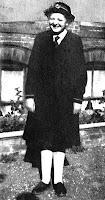 in the album wearing such an object. I am not sure of its purpose, other than to state that he was conforming. I don't think he saw it as a style statement as stylish dressing wasn't Daddy's forte. Maybe it kept his bald patch warm and dry.
 in the album wearing such an object. I am not sure of its purpose, other than to state that he was conforming. I don't think he saw it as a style statement as stylish dressing wasn't Daddy's forte. Maybe it kept his bald patch warm and dry.
Mamma wore hats only on posh occasions and, to be frank, they rarely suited her. I have an abiding memory of a lilac gauze-covered "coolie" hat that she wore a fair bit, mainly to Townswomens' Guild conventions. She kept her hats on the top of the wardrobe. I had the prescience to know that hats and I are not destined to be happy companions and I didn't try on her hats; played with her jewellery box, tried on her high heels, yes, hats, no.
My first memory of wearing a hat was when I started at Grammar school. The uniform required a velour hat in winter, straw boater in summer; later we wore berets. It didn't really matter, I hated them all and looked grim in them. If I could have invented an allergy or religious reason to be let off wearing them, I would have done. There is a picture of me wearing a knitted bobble hat at the Proms, but I think I only donned it for the photo as a gesture of solidarity as we had knitted them ourselves.
Hats mess up my already rather fragile hair, blow off in the wind and I only wear them if my head is threatening to freeze or the sun is threatening to burn my shoulders or turn my hair a neon orange.
I think my attitude to fascinators is affected by seeing a very drunk Irish woman at a very posh wedding in Wicklow a few years back, abusing the staff in colourful and slurred language while a ridiculous black feather contraption waggled about on her head.
I went to a wedding the other week and there were all manner of hats and fascinators dancing about on people heads. Not on mine, though, and that's a promise I've made to all who invite me to weddings (including in the unlikely event of my being mother of the Bride).
Maketh Man
Today
A big discussion on Facebook recently about mannerly behaviour. Comments on FB can travel a long way and it surprises me that people don't monitor their remarks or seem to be aware that FB is read by children, older people, even their parents. And my most mannerly nephew John was expressing despair over people's unpleasant behaviour that leads to all sorts of unkindness and even cruelty.
It's impossible to change the world, but you can influence your bit of it by refusing to resort to vulgar language or behaviour and by treating others with respect and attention. Of course, there are cultural differences, but a little thought quickly sorts that out.
And some people just fit into the category of "nature's gentlemen and ladies"; without learning a complex set of rules, they have a natural courtesy that comes from within.
In My Day
Daddy was certainly one of nature's gentlemen. He had natural ebullience, originality, charm and generosity that overcame any objections that could be made on the basis of his poverty-stricken background. His mother had tried very hard to give him the kind of good manners that come from the heart and these he passed onto us. For example, not to watch what others ate, counting anxiously every mouthful in case they had more, and he always gave people a courteous hearing.
Mamma's background was more straightforwardly upper middle-class, although with a German twist. She never fully mastered the labyrinthine details of English posh manners, but her inability to tell a lie and complete lack of snobbery stood in their place very well. I never once heard her make a barbed remark or act vindictively.
Of course there were tricky moments. On one occasion Paul's mother had invited my parents to a meal at Ravenhurst. She pushed the boat out with snow-white napery, silver candlesticks, the lot. Unfortunately, as she wasn't the world's best cook, the meal itself was just short of disaster, with limp vegetables and soggy pastry. I guess she realised this, but instead of shutting up she said effusively to Mamma, "I'm sorry it's so plebeian." She was clearly looking for reassurances that all was well. Mamma, who, remember, never lied, said "Well you are plebeian, why try to be anything else?" There was a frosty silence and quick change of subject. How well I understood both viewpoints.
Tricia, who had also had an early struggle, found it hard to differentiate between the form and substance. There's a famous family story which she told us many times. One of her boyfriends was a major with a double-barrelled name. She told the tale of going out to dinner with this man. The Maitre D came over to check that all was well and the major asked for his name. "Mr Smith", was the reply. "Well," snorted our double-barrelled hero, "I hardly thought you were Mrs!" This story was intended to show up the Maitre D's low oirigins in that he didn't know that the norm at that time was simply to bark out your surname. One day, I'd had enough. "Well, " I said, "I think that was very rude." "Oh, quite," said Tricia "The man simply had no idea." "No, I mean your friend Major what's his name. The man was simply doing his job and he was humiliated in front of you for a very minor faux pas." Tricia, to do her justice, paused, considered, conceded and, best of all, never told the story again.
These days we have lost many of the forms of manners, so we will just have to rely on the manners that come from the heart.
Sunday, August 09, 2009
Sing your heart out
Today
I'm getting ready for my annual visit to Cropthorne. What could be better than a few days in a beautiful spot, among friends, singing some of the World's most ravishing music?
Paul usually comes along for the ride, and spends his time relaxing in the gardens or visiting the local preserved railway.
I've been appointed the official archive-keeper (how interesting it is, to realise how accurately people observe you!) and have spent the last few days bringing the records up to date.
In My Day
I realise that I've been going to Cropthorne for 17 years. Now this isn't a publicly advertised event, something that appears in your junk mail or even on the more specialised ads connected with musical or choir groups. It's strictly invitation only. So I'd never heard of the Laetare Singers. It was at a rehearsal of a madrigal group to which I belonged that my friend Neill slipped me a piece of paper which was the invitation to join this event. He said nothing more about it and I assumed that it was open to all. I applied to go. It was only for four days and surely Paul could cope without me.
A couple of days later I received a call from a lady called Barbara Johnson. She sounded a bit schoolmistressy and began to question me about my credentials for joining the group. Did I sight-read? Was I in a choir already? I thought she was going to ask me about my social background and genealogy. Clearly you had to be someone special to join this lot. I began to despair of being good enough. Eventually I said desperately, "I'm a friend of Neill's." "Ah, well," said Barbara, as if I'd said "open sesame", "That's fine - we look forward to meeting you."
On the day in question I set off alone and found the spot without too much difficulty. Cropthorne is a lovely Worcestershire village near Pershore and Holland House, a Jacobean house, sits on the banks of the Avon in restful gardens.
There were about thirty people there, most of them over sixty in age and I felt very much the youngest. I only knew Neill and his wife. Barbara turned out to be an elderly lady with the appearance and demeanour of Queen Victoria and she ruled over the cultural, social and moral aspects of the event with smiling inflexibility. We were led by a conductor called Peter Johnson and I learnt many things and was given an opportunity to show that I could still hit a top "C".
There was also an evening where the group put on a more home-grown, light-hearted entertainment and my penchant for dressing up and acting foolishly was quickly identified and harnessed for a Cropthorne version of Macbeth.
Since that time, strangers have become friends and I have now become one of the over-sixties. "Laetare" means "rejoice" and that's exactly what I intend to do.
Friday, August 07, 2009
Deed Poll
Today
Very pleased that the Bed Workshop has agreed to pay for the cost of the repair to our French bed. "I'd like the cheque payable to Alice Barrett, please," I said.
As a result of the somewhat absurd money-laundering precautions, all my bank accounts have to be in my legal, rather than used name. Even though my account does indicate my "known as" name, I often encounter jobsworth cashiers in my bank who refuse to accept cheques made out in my used name, even when they know me by sight.
When I protest, their helpful advice is to go and change my name by deed poll. This I refuse to do merely for the convenience of the bank's regulations.
In My Day
It came as a sort of unshocking surprise to Paul when his mother informed him that the surname he'd been called by all his life wasn't actually legally his; Dad being his stepfather, not his natural father.
She gave him his birth certificate and left him to his own thoughts on the subject.
For a while, it didn't really matter. He continued to be known by the same name, officialdom being rather more relaxed in those days, and he didn't own a passport.
When he wanted to get married, however, it was altogether different. He had no desire to marry using the legal name to which he felt no connection. We discussed perhaps adopting mine but that didn't seem quite right. So Paul went to a local solicitor and changed his name to the one he'd always used anyway. Simple!
We still have that scrap of paper, proving not only that he did the deed, but also where he felt his filial loyalties lay. And that's as important as the name itself.
Wednesday, July 29, 2009
A Question of Talent
Today
Coming back from the gym today, I listened with great pleasure to a performance of the overture to "The Bartered Bride". What a joyous piece it is. I was reminded of an equally joyous WNO production many years ago, which opened with a harvest scene filled with golden light, looking liked a Millet painting. I thought about how the set designer would have researched to find the right ambience and collaborated with the lighting designer to produce that autumnal warmth.
In My Day
I don't know what it was that made me decide that I should pursue a career in theatre design. Perhaps doing a couple of school plays to some acclaim inspired me. Or maybe I just thought it sounded cool.
I was offered a place to do a City & Guilds at the West Sussex College of Design in Worthing (not a very cool place, I know). I joined a fairly motley group who had a variety of skills, from the strictly practical, woodworking category to the solidly artistic.
I turned out to be a fairly competent carpenter and could knock up "flats" for stage sets quite easily. I even learned how to make mortise and tenon joints, although I've now forgotten the knack.
I wasn't bad at making costumes and produced fairly convincing corsets. And once I produced a model of the interior of Chichester Cathedral for a performance of "everyman".
But I wasn't particularly talented. My designs were mediocre and my drawing only so-so. I used to gaze, enchanted, at the stylish and original designs produced by my classmates. What had I been thinking? It was in this spirit that I applied to train to teach art in secondary schools, an only slightly less deranged decision than the one to study theatre design.
After our final exams we were all given work placements. Mine was an assistant in the ladies' ballet wardrobe at Covent Garden. My main duties, it seemed, were to replace the feathers on Margot Fonteyn's Swan Lake costume, daily, and to hold pins while ballerinas were fitted into their costumes. I found the atmosphere stifling, both physically and socially and was very glad when my placement was over. I never thought of asking for an extended stay or a placement elsewhere (I might have been given the men's ballet wardrobe) and was simply relieved to be shot of it.
I don't know whether any of my colleagues from Worthing ever entered the world of theatre but have a sinking feeling that even those who did remained bottom of the heap.
My experiences have certainly caused me to question the ability of eighteen-year-olds to make realistic judgements as to their futures, and made me glad that I had the sense to cut and run.
Monday, July 27, 2009
Frocks
Today
I went to a wedding yesterday. Paul had offered the Bentley to the Bride's mother, so we drove over to the Bride's tiny house as the rain clouds gathered. In the house there were the Bride, seven bridesmaids, a pageboy, a makeup artist and the parents of the bride. Four of the bridesmaids were fully-grown women of considerable stature and the bride was no midget, either. As we squeezed in the front door the coat rack crashed to the floor, taking some plaster with it.
The Bride, wearing nothing but a white bustier, tracksuit bottoms and her veil, greeted us loudly. Given the chaos, the obvious thing to do was to get stuck in; sorting out the little ones' tiaras, stitching up bits of the Bride's dress, shoe-horning the chief bridesmaid into her dress and drinking champagne.
Eventually we all set off, in the right order, with only a little of the Bride's voluminous train catching some mud on the hem.
In My Day
My sister Beatrice was married, at the age of eighteen, at All Saints' Church, Upper Norwood. This was a very do-it-yourself affair and I had been given the responsibility for making the Bride and bridesmaids' outfits. Like yesterday's bride, Beatrice was not petite, and I came up with a Russian theme for the affair (well, I was at theatre design college at the time). I made Beatrice a full-length, ivory wild silk dress, with a high collar and many-many silk-covered buttons down the front and along the deep cuffs of the sleeves. The bridesmaids wore peasant style outfits with hand-embroidered blouses, waistcoats and skirts.
These affairs are never without their cliff-hanger moments; I was running out of time on the skirt embroidery so Mamma completed one - I can always tell which because she slightly overdid the tension.
My flatmate Sue, trained in theatrical millinery, agreed to make the headdresses. I sent her the fabric and money for the additional bits and pieces. The wedding approached; no sign of the headdresses. I couldn't get hold of Sue on the phone. The night before, I hastily stitched some snoods which I thought would do. I abandoned all hope of finishing my own dress and whizzed up to Crystal P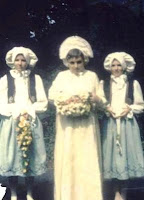 alace to buy one.
 alace to buy one.
At one in the morning Mamma stitched flowers onto the muff which Beatrice was having instead of a bouquet.
The morning of the wedding arrived, along with the postman, who bore a large box containing the headdresses. Three wonderful Russian-styles creation were revealed and pinned onto the Bride and maids and my snoods were put aside.
The final cliffhanger moment was also to do with dresses. Beatrice arrived at the church before the choir (consisting of me, brother David and friends Frances and Gregory) had fully assembled, because Frances was also trying to finish a hastily cobbled-together dress and had ended up fixing the hem with Sellotape. She and David dashed in, about a quarter of an hour late, while Beatrice sat in the church porch, waiting patiently until we could sing her in.
While I can see the attraction of one's wedding arrangements operating like a well-oiled machine, it's often the more home-spun elements that bring back the memories most vividly.
Friday, July 24, 2009
Flood II
Today
Once again, we discovered that torrential rain had overpowered the gutters at no9, chucking water at the small bedroom windows and sending water running down the rear corridor. Fortunately, Frank and Maureen had popped in and stemmed the tide using my towels. Frank made some further adjustments to the door's own drainage system to try to make the water run away, rather than inside.
That's the 2nd time in a month - just one of the hazards of owning an old property, one might think.
In My Day
Certainly, older properties were, even at the time of building, less protected from the elements and wear and tear does take its share.
I don't remember large scale floods at 4bh; the effects of the elements were far more subtle, just as damaging and a lot more sinister.
I guess we had colder winters then; certainly there was often a cold snap and Daddy would start to worry about our water supply which was provided by lead pipes between the floors. Now lead is a relatively soft metal which doesn't expand and contract very well. For reasons that I don't understand, our pipes were never lagged. Water would freeze in the pipes, expanding and causing a split somewhere in the weakest point of the system. The trouble was, you couldn't tell whether or where this might have happened until the water thawed, when water would then leak through the ceiling.
This might be given away by a brown patch on the ceiling or a wet patch on the floor. Often you could hear the "drip" "drip" but not see it and some detective work was needed to find its location. Buckets were requisitioned to catch the water. Dealing with the leak involved taking up floorboards and applying a blowtorch to the affected part until the lead melted and rejoined.
The whole process was quite spooky, we feared this insidious internal destruction of our house deep within its structure. I was always anxious in case the ceiling came down or we were engulfed in water.
We used to call this phenomenon simply "The Drip" and it caused as much fear as any Stephen King film, especially to Beatrice who was absolutely terrified and probably would have preferred the weather to be freezing all year round, rather than endure "The Drip", dip-dripping.
At least at the flat our purchase of an extravagantly high-quality carpet has been justified as it's simply shrugged off the dirt.
Saturday, July 04, 2009
Flood
Today
It comes to something when your sister prompts you to write the next blog instalment.
Another of those Internet "getting to know you" quizzes "20 things I'll never forget", which, as usual, I was quick to complete. Beatrice's comment on mine was "more on the fishtank in the till incident, please"
Here goes
In My Day
Was it 1998? We were in Kilcrohane, just Paul, me and the girls. Visits to Eileen's were de rigeur where we usually wound up the day. One of her regulars had paid a visit to Skibereen fair where they'd won a fish. You know, one of those wretched creatures in a plastic bag circling hopelessly with a vacant expression.
With a grand gesture they gave the fish to Eileen, who now had to locate a fishtank and somewhere to put it. She found a tank from somewhere and squeezed it into the tiny space above the till below the wine bottles. This was before the smoking ban which might be why the fish itself didn't last more than 48 hours, or maybe it didn't like the noise or the journey back from Skibereen. The expired fish was removed but somehow Eileen didn't quite get around to removing the tank.
Saturday night was, as usual, crowded and noisy at Eileen's. Vigorous discussions, jokes, flirting and snatches of song. Somehow, no-one noticed that it was way past closing time, as we all partied. Eileen just kept on pouring the Guinnesses and taking the money, faster and faster.
All these rapid movements were her undoing; with a sweeping gesture she knocked the fishtank into the open till. Water got into works and the till started spewing out paper receipts without stopping. As these curled onto the floor, the punters demanded more drinks and laughed even louder, Eileen tried to get onto her support helpline. It was about half-past twelve at night, so the helpdesk was probably on skeleton staff. Eileen couldn't hear what they told her, couldn't hear herself speak and the till kept on churning. Using her vast store of expletives, Eileen told her customers to shut up. Which instruction they completely ignored, shouting jibes and encouragement.
I don't know how the evening finished; I expect the till ran out of paper. Eileen decided that she could take money for drinks without a till, business being business. I think she turned the till upside down to shake out the water and hoped for the best.
We left the pub at about one am, stumbling the few yards back to Fawnmore, leaving the revellers who kept things going till about three.
Just another normal day in Kilcrohane, then.
Sunday, June 28, 2009
Fares, please
Today
We decided to enter Brighton via the London Road today. This was a mistake as the traffic was practically stationary from the A27. The driving we saw was appalling. Eventually we could no longer stand seeing the people in the car in front of us chucking their rubbish out into the road. "I know an alternative route", said Paul, dashing off up Carden Avenue. I questioned his choice of route. "I know Brighton", said Paul "this will get us to where we're going". And he was right.
As we drove along Ditchling Road, I said "You used to drive buses along here. Does it feel like another lifetime to you?" "It certainly does", replied my spouse.
In My Day
After a brief and unsuccessful sojourn with the police force, Paul was looking around for another job. We were just married; I was at college and we were living off my overdraft. Brighton, Hove and District Buses were recruiting at the time and Paul applied. "Well..." they said "we don't normally take people under 23 years of age but come and have a test drive." They were impressed enough to offer him the job and, at 21, Paul became the youngest member of the company ever to hold a PSV licence.
The buses were double-manned with conductor and Paul was immediately allocated a punishing schedule of routes. I remember how dull it was, waiting for him to come home after a shift. Sometimes I was so bored I'd travel round on the bus with him - but that was pretty boring too.
On more than one occasion a bus would break down and he would be stuck in some back of beyond place like Whitehawk or Moulescombe, waiting for the breakdown truck to get him back to the depot. We had no phone so I simply had to wait until he turned up and told me lurid tales.
Some of the buses still had crash gearboxes and it was quite a challenge manhandling these beasts up and down the hills of Brighton. Paul told me of one hair-raising experience coming down Beaconsfield Villas towards the London Road when the brakes on the bus failed. As Paul struggled with the gears and handbrake the bus sailed past several stops where passengers simply stared as the bus whizzed by. Inside the bus there was a standing load and passengers again just had to watch as they missed their stop. With a cliffhanger finish worthy of "Speed" Paul pulled up the bus just before it reached the London Road. A few years back, Paul came across a picture of the very same bus and was amused to discover that it's now a motor home in Switzerland.
And all this for £14.00 a week. When a better-paid job came up at the local funeral parlour Paul gave up the joys and terrors of being on the buses and entered the strange world of the undertaker.
Paul still has a love affair with buses, though, and I've learnt quite a lot, perforce, about them too.
Saturday, June 27, 2009
TGIF
Today
On Facebook yesterday a chorus of welcome for Friday, in which I joined. It's curious, really; now that I've been retired for three years, you'd think that the days would simply roll into each other and that we'd ignore the Friday factor. Not so; we still treat Friday night as special. We are less likely to watch telly (unless it's BGT) or work, I'm more likely to cook up a special meal, listen to smoochy music, drink more wine or invite friends over. In fact our (also retired) neighbours came over last night and we put the world to rights over several bottles of wine and real ale until midnight. I'm sure on other nights that we all go to bed earlier and drink less.
And it's different from Saturdays which are for the Big Night Out and more serious socialising.
In My Day
I first heard the expression "TGIF" when I worked in the Inland Revenue's enforcement office. It was used with (eventually boring) regularity by an older officer - an Irishman by the name of Joe Beckett.
When I was a child Friday night meant having Daddy at home. Daddy's job with Hansard entailed late nights the rest of the week; with him returning home at ten pm or later. On Fridays he'd arrive home at about six O'clock. The whole dynamic of the evening was different. Often he would have brought some fish with him - mackerel or herring, which he might cook himself - rolling the fish in porridge oats before frying. I really disliked the fish but that smell could only occur on a Friday. It was also the only time, apart from the occasional Saturday when Daddy would make us a fried breakfast, that Daddy cooked.
There was no school on Saturday, either, so we could stay up a bit later and there might be games or at least very lively conversation and discussions. Friday was so unlike other evenings which were altogether quieter and involved chores and homework.
This attitude to Friday (as distinct from Saturday) spilled over into many areas of life. At the Proms, for example, the avant-garde was saved for the beginning of the week, the big pieces for Saturday. Fridays would offer a night of jolly good, rousing celebratory music, culminating in the traditional Beethoven's Ninth on the penultimate night.
So I think that Friday is now hard-wired, so to speak, into the nation's psyche, and no amount of being retired or working at weekends will change it.
Thursday, June 25, 2009
Cold Turkey
Today
While spooning out the saute potatoes onto Paul's dinner plate last night I accidentally nudged my own and watched in horror as the plate slid off the worktop, somersaulted and landed, dinner-side down on the floor. Now, I do keep my kitchen floor clean, but not so that one would actually eat one's dinner off it, and anyway, cheese omelette responds badly to being dashed to the ground. Also there were chips of crockery everywhere.
I felt a bit irritable about this, understandably. Paul shared his dinner with me and later we made up for it with a glass or two of Pimms taken beside the chimenea in the twilit garden.
I complained on Facebook and Beatrice said "Do you remember the strange incident of the turkey on the floor?" Indeed I do.
In My Day
When we lived at Montfort Close we had room enough in an extension to seat a fair number of dinner guests. Once Christmas (1984, I think) we invited the following number of guests to share it: The Levetts (who only had two young 'uns in those days), Beverley's Parents, Mum, Claire and Beatrice and her then spouse Nick. Fourteen in all.
I boldly offered guests their starter of choice (I think Beatrice demanded, and got, caviar) and Beverley and I set to and made a traditional Xmas lunch. Beverley had lent her pressure cooker so that the veg could be cooked speedily.
After the starters and with wine having started to flow freely in the next room, we went off to serve up the main course. I had recently acquired a very expensive, top-of-the-range gas cooker which guaranteed that the oven shelves would support 25lbs on their anti-tilt cantilever system. The turkey weighed about 23lbs, but perhaps I should have taken into account the weight of the tin. Whatever; as I pulled out the oven shelf, it did indeed tilt. The tin went one way the turkey the other. I reached up and caught the turkey in my arms (I always was good at throwing and catching).
This act covered me in very hot fat and the turkey slid to the floor as I yelped and rapidly discarded my clothing. Paul rescued the turkey and gave it a quick rinse under the tap. I dashed upstairs to change. The ignored pressure cooker hissed away. I hastily invented some gravy, Beverley removed the now hopelessly overcooked veg, while guests in the next room loudly sang "Why are we waiting".
Eventually we made our triumphant procession into the dining room and allowed guests to think that the delay was due to my vanity which had necessitated me changing my clothes. We didn't mention the heap of clothes on the floor of the kitchen, congealing under turkey fat or the slight blistering burn on one of my boobs. And the rest of the meal went very well.
However, I was sorry that one of my very nice grey faux crocodile high heels never recovered from its soaking and had to be chucked.
Tuesday, June 09, 2009
Hog's Back
Today
I am not a person who enjoys living in the past. You might think that the existence of this blog rather contradicts this statement. But this blog is intended to shine a light on how I have lived my life; I don't spend my days trying to recreate it.
However, last weekend, recreate the past is just what we did. Paul and I participated in the London to Brighton Classic Car Run, driving his Humber Imperial. We meet lots of people, all enjoying this little dipping of the toe into the 30's or 50's and many passers-by say things like "they don't make them like that any more!" (Which may be a good thing.) The run always starts from a location in Surrey - this year from Brooklands near Weybridge.
We drove up the evening before and decided to eschew the M25 and cut across country via Farnham. We took the A31 across the Hog's Back, skirted Guildford to pick up the A3.
"I used to cycle these roads", I said to Paul "But the A3 wasn't this terrifying 3-lane dual carriageway in those days. I wouldn't do it now."
In My Day
I was given a bike when I was about 12. Not being naturally sporty, I took a little time to learn and can remember the moment when I managed to "do it by mineself". The boys and, later on, Beatrice had bikes . We frequently took ourselves off cycling the North Downs and I can't remember Mamma or Daddy expressing any anxiety; probably they charged the boys with keeping an eye, but I was blissfully unaware of this.
We were all capable map-readers and I quickly learnt how to recognise road numbers and names. Roads south took us through Croydon, almost inevitably. East - through Addiscombe to cycle into Kent and that long curving road (not really changed today) into Sevenoaks.
West, maybe through Waddon with its chocolatey Paynes Poppets factory. South along the Purley Way. A favourite route took the A25 via Leatherhead (where David went to school) and along the A3 and the A31 Hog's Back Road. The Hog's Back is one of those amazing roads which travel along the edge of the North Downs - the slopes north to London and the escarpment down to Godalming and the Devil's Punchbowl to the south.
Of course there were lorries on the road in those days, but far fewer and certainly not the huge continental artics seen today. The roads, even the A31 dual carriageway, were far less busy and didn't seem at all terrifying. So the rides were enjoyable challenges; struggle up the hilly bits, ride through the "jelly-leg" that would set in after about 10 miles or so and enjoy stopping at a beauty spot somewhere or other. And the A3 was just an ordinary road; 20 years later, which was the next time I drove along it, I was astonished by this high-powered arterial road, driving straight into London.
It was quite normal for us to cycle twenty five or thirty miles, arriving home, dusty and tired, with an enormous appetite.
It does seem ironic, with our current anxiety and using up our energy resources and encouragement to get our our bikes, that the roads are so much less easy on the cyclist than they used to be.
Sunday, May 31, 2009
Great Western
Today
The weather was perfect yesterday. So, of course, the best way to spend it involved a total of five hours' driving and another couple of hours in a hall filled with smelly people hoping for a bargain and equally hopeful stall holders.
Yup! we were at a toy and model fair which was held at Sandown Park Exhibition Centre in Esher. Paul, of course, loves these affairs, and often finds that other commitments prevent him from going. And he doesn't like going without me.
So there we were, looking at rows and rows of (to me) indistinguishable model cars, and every variety of model railway loco, rolling stock and other bits and pieces.
Every now and then, tucked away among the Hornby Dublo (very 2nd hand) items there would be little booklets - a lot of them were old catalogues, but there were others on the history of GWR or some such thing. They were all tatty little cheaply printed paperbacks, dating back about 60 years. I rummaged about, looking for some very special books, but no luck.
In My Day
The little booklets for which I was searching, were published by the Western Region (or was it GWR?) and contained stories from the west country. I think that there were four of them and that the covers were printed in the famous banana split colours of the Western Region. When I was a child, I devoured everything that could be read, including these.
These little books were full of legends, folk and fairy tales from the West country. They told of Cornish Piskies who'd steal your babies if you didn't leave milk out at night, of Sundays revellers being turned to stone in the middle of their blasphemously played hurling match (just what was hurling?). I read of mermaids tempting Cornish fishermen, about the Rollright stones whom no-one has ever been able to count, who go down to the river to drink at night time. St Neot was the miniature Cornish saint, or so it seemed to me, never heard of in London and I read of St Michael casting down the Devil from St Michael's Mount. Then there were lurid tales of smugglers and wreckers and hidden caves in cliffs.
The books, which I read repeatedly during those long nights when sleep eluded me, led me into a world populated by superstitious Celts and made me feel that the "West Country" was indeed a foreign place.
I've no idea what happened to those books and would dearly love to find a set. I wonder if I could find some on eBay?
Monday, May 25, 2009
Golden Dome
Today
We've made the decision to spend this New Year in Wiesbaden. We'd toyed with going back to Madeira or Burgh Island, but, when I was playing around finding out how I could use my airmiles, I said to Paul "there's always Frankfurt." "Ah," he said "You know how much I've been wanting to go to Germany." So the deed was done.
"It's just round the corner from Wiesbaden", I said "so we could go and visit my cousins. And Wiesbaden is a really lovely town."
In My Day
In redemption of a long held promise, Mamma took me to Wiesbaden as a reward for passing my 11+. She herself had not returned to Germany since first coming to England so I guess it was as big an adventure for her as for me. Her doctor sister was now living in Wiesbaden with her husband and three daughters, one of whom, like me, was named Julia after our grandmother.
We travelled via boat to Ostende and then train to Wiesbaden. We stayed at A unt Maria's apartment on the Schiersteiner Strasse. The summer of 1959 was a hot one and I remember spending much time out of doors in this elegant spa town. There were beautiful gardens in which red squirrels played, churches that looked like Disney fantasies and a building with golden domes that gleamed in the sun.
We visited the spa swimming pool where we frolicked in the foaming and spurting hot spa water and took a boat trip along the Rhine, marvelling at the fantastic castles and seeing the Lorelei rock with its siren connotations.
I remember tasting the wonderful German pastries and ice-creams (these were often forced upon us by the need to find a toilet; it's surprising how often you need to go, when there's a dish of mixed icecream ornamented with little parasols awaiting you). Culture wasn't neglected either; we went to hear the Vienna Boys' Choir, a peculiarly Teutonic treat, where I had my first taste of Pepsi-cola.
Mamma, Maria and Uncle Jochen are long since dead but it will be fun to see my cousins again. And I bet New Year celebrations are really beautiful in Wiesbaden. I wonder if we'll have snow?
We've made the decision to spend this New Year in Wiesbaden. We'd toyed with going back to Madeira or Burgh Island, but, when I was playing around finding out how I could use my airmiles, I said to Paul "there's always Frankfurt." "Ah," he said "You know how much I've been wanting to go to Germany." So the deed was done.
"It's just round the corner from Wiesbaden", I said "so we could go and visit my cousins. And Wiesbaden is a really lovely town."
In My Day
In redemption of a long held promise, Mamma took me to Wiesbaden as a reward for passing my 11+. She herself had not returned to Germany since first coming to England so I guess it was as big an adventure for her as for me. Her doctor sister was now living in Wiesbaden with her husband and three daughters, one of whom, like me, was named Julia after our grandmother.
We travelled via boat to Ostende and then train to Wiesbaden. We stayed at A
 unt Maria's apartment on the Schiersteiner Strasse. The summer of 1959 was a hot one and I remember spending much time out of doors in this elegant spa town. There were beautiful gardens in which red squirrels played, churches that looked like Disney fantasies and a building with golden domes that gleamed in the sun.
We visited the spa swimming pool where we frolicked in the foaming and spurting hot spa water and took a boat trip along the Rhine, marvelling at the fantastic castles and seeing the Lorelei rock with its siren connotations.
I remember tasting the wonderful German pastries and ice-creams (these were often forced upon us by the need to find a toilet; it's surprising how often you need to go, when there's a dish of mixed icecream ornamented with little parasols awaiting you). Culture wasn't neglected either; we went to hear the Vienna Boys' Choir, a peculiarly Teutonic treat, where I had my first taste of Pepsi-cola.
Mamma, Maria and Uncle Jochen are long since dead but it will be fun to see my cousins again. And I bet New Year celebrations are really beautiful in Wiesbaden. I wonder if we'll have snow?
Saturday, May 23, 2009
RIP
Today
Eventually we did the only sensible thing and had Lizzie's lawn re-turfed by a professional. Looks lovely too, and Liz actually mowed it about three weeks ago.
She planned to do it again two weeks later and was horrified to see just how fast grass grows. In fact I did it for her a few days earlier (just as well as it rained on the weekend she had set aside).
As I got to the bottom damp bit I saw a little creature slither off in the grass. I asked Paul "Are grass snakes brown?" "Yes", he replied. I spoke to Lizzie about it and she said "Oh, I know - I saw it last week and took a picture." I talked to a know-it-all type of chap down at the local cookshop and was quizzed on whether it had yellow spots behind the eyes (essential for a grass snake) - "I don't know, I was trying to get it out of the way of the mower blades by lifting it on a stick." "Of course, if it's dark brown it could be an adder," he went on with relish "they do exist on the Mendips."
I researched via good ole' Wiki and decided that the slim, silky cafe latte coloured creature I'd seen was actually a slow-worm which is neither a worm nor a snake, but a legless lizard which is good at ridding the garden of slugs but defenceless against cats.
Did the grass again today and spotted several of them slithering around where the grass was longest and dampest.
In My Day
I'm a real townie and have not only never seen a snake in the wild, but am profoundly ignorant on the subject as well. The garden at 4BH was large and overgrown so grass snakes and slow-worms were a possibility, but I never saw any.
When we went for walks led by Mamma my brothers were very fond of discussing whether we'd see adders up on the sandy country around Godalming or on the Weald. They were full of stories about how to deal with a snake-bite (slice the wound and suck, apparently) and probably enjoyed terrifying their little, gullible sister. I made sure to stamp on the ground to scare them away whenever we were in heathland on hot days. We probably all made so much noise that any self-respecting snake could hear us coming for miles.
When we lived at Rowan Avenue, Frannie found a slow worm which she kept in her pocket and tried to feed on grass until her ophidiophobic mother made her throw it away very far from the house.
I regret to report that one of the slow-worms in Lizzie's garden was too slow to avoid the mower, meeting his end via the whirling blades. I am so sorry, slow-worm and will be more careful in future.
Eventually we did the only sensible thing and had Lizzie's lawn re-turfed by a professional. Looks lovely too, and Liz actually mowed it about three weeks ago.
She planned to do it again two weeks later and was horrified to see just how fast grass grows. In fact I did it for her a few days earlier (just as well as it rained on the weekend she had set aside).
As I got to the bottom damp bit I saw a little creature slither off in the grass. I asked Paul "Are grass snakes brown?" "Yes", he replied. I spoke to Lizzie about it and she said "Oh, I know - I saw it last week and took a picture." I talked to a know-it-all type of chap down at the local cookshop and was quizzed on whether it had yellow spots behind the eyes (essential for a grass snake) - "I don't know, I was trying to get it out of the way of the mower blades by lifting it on a stick." "Of course, if it's dark brown it could be an adder," he went on with relish "they do exist on the Mendips."

I researched via good ole' Wiki and decided that the slim, silky cafe latte coloured creature I'd seen was actually a slow-worm which is neither a worm nor a snake, but a legless lizard which is good at ridding the garden of slugs but defenceless against cats.
Did the grass again today and spotted several of them slithering around where the grass was longest and dampest.
In My Day
I'm a real townie and have not only never seen a snake in the wild, but am profoundly ignorant on the subject as well. The garden at 4BH was large and overgrown so grass snakes and slow-worms were a possibility, but I never saw any.
When we went for walks led by Mamma my brothers were very fond of discussing whether we'd see adders up on the sandy country around Godalming or on the Weald. They were full of stories about how to deal with a snake-bite (slice the wound and suck, apparently) and probably enjoyed terrifying their little, gullible sister. I made sure to stamp on the ground to scare them away whenever we were in heathland on hot days. We probably all made so much noise that any self-respecting snake could hear us coming for miles.
When we lived at Rowan Avenue, Frannie found a slow worm which she kept in her pocket and tried to feed on grass until her ophidiophobic mother made her throw it away very far from the house.
I regret to report that one of the slow-worms in Lizzie's garden was too slow to avoid the mower, meeting his end via the whirling blades. I am so sorry, slow-worm and will be more careful in future.
Friday, May 22, 2009
Material World
Today
I'm in the middle of a sewing bonanza at the moment. I have three cupboards bulging with fabrics, all of them begging to be made into clothes, cushion covers and handbags.
I have everything from suiting lengths (real bargains, especially as I now never wear suits), cute organza remnants ornamented with hearts or little puppies to a truly fabulous silk and gold thread sari length that cost a fabulous amount.
That's right, you've got it, I'm a fabric junkie; I can't walk past a remnants bin with any kind of self control. I popped into C&H fabrics in Brighton the other day with the intention of buying a few essential haberdashery items and returned with a length of quilted silver and black fabric (will it make place mats for F2/9?) and some very jolly stretch fabric foil printed with red spiders' webs. This last I'm attempting to use to cover some bolsters for Lizzie, but the stuff keeps fighting back.
In My Day
As someone whose school reports for sewing at best said "fair", I wonder how I developed my passion for sewing. Perhaps the change came when I saw how to make items one might actually want. At primary school and the first terms at Grammar school we mainly made embroidered gingham aprons. They always were deeply unstylish, embroidery on a garment that was likely to be splattered with grease and flour seemed quite unnecessary and maybe, in my deeper mental recesses, I objected to my introduction to sewing being to make a garment that reinforced woman's role as a servant. (The boys didn't do any such thing; in fact they didn't even learn to sew.)
When I was about seventeen I became involved with designing and making costumes for the school play - my piece de resistance being costumes for AMSND. Fashions at that time were mainly little shift dresses that took about three yards of fabric. I soon worked out how to make these for myself. I began to savour the delights of rummaging through fabrics at Alders in Croydon or, delight of delights, John Lewis in Oxford Street. I once made a coat dress out of turquoise sailcloth with orange lining and a fake kipper tie made out of orange, another time a shirt dress out of pure Wild West check. I sewed Beatrice's wedding and bridesmaids dresses and made clothes for my mother.
When the girls were little and I worked in Lewes I used to pop into the warehouse owned by Clothkits and buy bales of slightly flawed kits for £1. These made heaps of clothes and bags for all the children in the family.
The trouble is, my incentive to actually do any sewing has somewhat fallen off in recent years but my love affair with fabric hasn't. I've now several great-nieces who will be needing pretty clothes, tho'. Hmmm, must see what there is in the sales.....
Saturday, May 16, 2009
Thermostat
Today
Why is it that the minute you decide that it's time to turn off the heating for the summer the temperature plummets by about ten degrees? After a couple of weeks during which Paul complained about how hot the bedroom was getting when the heating turned itself on in the mornings, I decided it was time and turned the switch.
So today, with a high of about eight degrees manifesting itself, I'm freezing. The boiler will have to be turned on again tonight. At least with a modern gas combi-boiler it's relatively easy; I don't have to coax a coal boiler into creaking action.
In My Day
Mamma and Daddy had objections to central heating, the reasons for which I never entirely fathomed. As a child my experience of it was confined to school where we had ancient radiators that reluctantly became lukewarm after days of concentrated effort from a hidden boiler. Despite the layers of clothing into which I was bundled, I was often cold and we would all find excuses to cram around the radiators which did anything, it seemed, other than actually radiate heat. The heat, such as it was, probably gathered in the hign ceilings. They were huge cast-iron affairs covered with layers of peeling and lumpy paint in places and rusty in others. Given their efficiency, they were rather all talk and no do.
The heating was always turned on on October 1st, regardless of whether we were experiencing an Indian Summer or not, and off on May 1st, even if it was snowing. The boilers were probably coal or coke-fired and required a lengthy period of stoking up and cooling down, and switching on and off was not to be taken lightly. They must have cost a fortune to run for so little effect. I expect it was quite warm in the boiler room, but I could never find any excuses to venture so far.
Unpredictable heating continued to be a feature of my life for many years; in the more affluent establishments, convector heaters might be wheeled in to help; in others where strict economy was the rule, you simply dressed to cope. Even at Flare we were for many years the helpless victims of an elderly system which was reliable only in that it would always break down when there was snow on the ground and often failed to bring a single office up to the required legal minimum of sixteen degrees. How excited we were when we at last were able to fork out the cash to replace it with a modern system!
In fact, I am beginning see to the point of Mamma and Daddy's objections; with coal fires you could at least predict the hot and cold spots, even if you had to cope with dirt, smoke blowing back, and chimney fires.
Saturday, May 09, 2009
Button to chin
Today
This morning I decided that the winter clothes must be put away. I went into the porch to collect Paul's winter coats for dry cleaning. "Do you realise", I said to Paul "That you've about 20 winter outer garments of one kind or another?" "Impossible!" He replied. "Well, when you take into account the six woollen overcoats, four leather coats/jackets, two waxed coats, a moleskin jacket, and an assortment of lined anorak type coats, I don't think I'm far off."
The coat racks both in the porch at home and at the flat groan with Paul's attempts to fend off the cold and my much more modest selection is relegated to a tiny corner.
In My Day
How was I protected from the cold when I was a little girl? You can sometimes see pictures from the '50s showing little girls in fitted woollen coats with cute little velvet collars - well I certainly didn't have one! I really remember how I was dressed on cold morning before going to school. Pile it on, seemed to the guiding principle.
Two pairs of knickers, a vest, a Liberty Bodice to which stockings were attached by suspenders, a blouse, gymslip, cardigan, blazer and gabardine mac. I could hardly move, yet there was a completely unprotected gap between the top of the stockings and my knickers. Otherwise I was warm enough, I guess.
When Paul & I were first married, my coat was made out of an old army blanket (a tailoring project at college) and Paul didn't have a coat at all. Apart from an Afghan coat of mine, which smelt resolutely and enduringly of goat, neither of us could afford a coat for years. We wore anoraks and cheap quilted jackets; once we even wore matching bright green logo-printed jackets that came free with some motoring promotion or other - which was a stylish look.
When she was very small Lizzy had a coat that had once been James's and later a coat bought in the sales. These resurfaced throughout the family, eventually returning to Becky. For quite a long time her only winter coverings were a couple of Aran zip up jackets made by Mamma.
Eventually I made her a coat in blue wool with cream lining and a piece of cream fake fur around the hood. My sister in law and I went halves on a piece of wool/alpaca; I bought a pattern and made a coat which I wore until it literally dropped into pieces. After that I got by with jumpers and anoraks for ten years. (Joan never got her coat made and I made her a parka from the fabric about twenty years later).
The truth is, coats were simply too expensive, particularly for Paul. Even fifteen years ago they could cost easily £200. It wasn't until I worked for Flare and received bonuses that these luxury garments could be bought. I bought Paul a proper coat about thirteen years ago - cashmere and wool - for Christmas. This he still has and wears with pride.
Given that really cold weather is rare these days, I think that Paul need never buy another overcoat. Not that that's likely to stop him, of course.
Wednesday, May 06, 2009
Viewpoint
Today
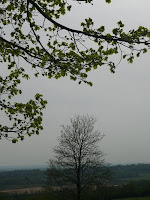
Yesterday was Daddy's birthday. He would have been 116 years old. I raised my cup of tea to him and remembered fondly. There was a legend within the family that, on Daddy's 100th birthday, we would all gather at his favourite place to celebrate. His favourite place was Caterham Viewpoint.
In My Day
We regularly made the trip to Caterham. It was an easy bus journey, broken at South Croydon with a walk up Tupwood Lane to the top. Tupwood Lane started in typical suburban Surrey manner with spacious houses and elegant drives, but gradually it became more rural with bluebell woods.
Nothing ever quite prepared one for the dramatic opening that was the viewpoint. At the edge of the North Downs, the steep scarp dropped away and one could gaze out towards the South Downs and imagine the sea just out of sight.
here was plenty of time to ramble through the adjacent woods and to play on the open space. Somehow it never seemed very busy, as though just we and a few discerning others had discovered it.

Later, when we had bikes, the boys and I would cycle there for no reason, it seemed, other than to cycle back.
After Daddy's death we planted a tree at the viewpoint with a plaque set into the ground beneath. When the first tree disappeared we replanted.
After Mamma's death Caterham somehow dropped out of our viewpoint. On Daddy's 100th only Beatrice, Lizzie and I were there to toast the now treeless plaque with champagne, although David had gone there the previous weekend.
And last year, the gathering of us and Beatrice's family found that even the plaque had gone, leaving a somewhat obscure concrete plinth still stubbornly adhering to the chalk.
Whatever happens at Caterham it's our viewpoint of Daddy as a force for good in our lives that really matters and endures.
Monday, April 27, 2009
Sunshine & Showers
Today
Raining hard in Brighton today after a beautiful weekend. Looking at the forecast I see that the weather this week is day on/day off with regard to rain and sun.
"I remember my holiday in Devon & Cornwall with Ann Bryant", I said to Paul "That's exactly what we had."
In My Day
When I was in my teens the best way to have an affordable holiday was to join the Youth Hostels Association. It was very cheap and offered accommodation throughout Europe where you were likely to be pretty safe, if not always comfortable. In England at that time there were fairly strict rules about getting to the hostels under your own steam and driving or hitch-hiking was much frowned upon. I wasn't a sporty girl but I did like my holidays to be active.
In 1965 I and my friend Ann Bryant decided that a cycling holiday around Devon and Cornwall would be just the thing. We booked accommodation in advance, staying at each coastal hostel between Plymouth and Exeter, heading westwards. We caught the train from Paddington to Plymouth where our adventures began.
Our bikes weren't especially top of the range; my bike had no gears and Ann's was a little Moulton. Given the hilly nature of the terrain, you can see that we spent a fair bit of time walking.
The hostels were extremely varied from elegant houses to tumbledown cottages that appeared to get their water from the well. Some of them offered breakfasts (a very few even offered supper) and we took advantage of this when we could. But often we found ourselves heating up beans over ancient stoves that ought to have been condemned and wrestling with recalcitrant toasters.
Our decision to stay at each hostel meant a very varied programme of distances to travel. Ideally, in an ideal summer, this should have given us some easy days during which we could potter about, take a scenic detour or catch up on our tans.
Unfortunately, the weather opted for a day on-day off approach to sunshine and showers. There were days when we seemed to make no headway against the Atlantic gales, peddling frantically and apparently staying still.
When you had fifty miles to go, this was rather discouraging. On one occasion - between Newquay and Padstow, the going was so rough and our headway was so slow that we gave in and caught a train which creaked its was across the moors taking probably longer that we would have done by bike, but at least we were dry. Between Tintagel (a rickety stony hostel clinging to the cliff edge and Boscastle was only six miles and we were looking forward to a day scrambling over rocks and exploring the coastline. Instead, force ten gales kept us indoors where we were probably the record holders for spending time at the Boscastle witch museum.
We did have some lovely days too - discovering the Minack Theatre by accident and watching a rehearsal for King Lear as the sun set over the sea, and cycling in sparkling weather from Minehead to Exeter along the beautiful Exe valley.
It was on this holiday that Ann shocked the locals by wearing very short shorts and causing one ancient to call out as we went by:"Yoo'm better pull yoom skirrt down; yooom paaants is showin!" as he cackled with laughter.
What the holiday taught me was to be self reliant and that the weather is not all that makes a holiday. And I remember just about every detail after over forty years.
Saturday, April 25, 2009
Cap and gown
Today
My sister graduated today with a BA in Eng lit and phil from the Open University. It's taken her seven years of hard work, concentration and commitment to get there and I'm just so proud of her.
There was a lovely ceremony at the Dome and we were reminded that the OU stands not just for social inclusion but also social justice. The honorary doctorate was awarded to Dame Stephanie Shirley whose life story was an example of triumph over adversity.
"You're the second Dixon of our generation to get a degree," I told her. Later there was a discussion about the benefits a degree can bring and Lizzie pointed out that Chris and I achieved a great deal and we neither have degrees. "It doesn't mean that you're totally handicapped if you don't have one," I said "And having a degree is an achievement in itself. After all, I'm finding studying for an NVQ hard enough!"
In My Day
Daddy couldn't have achieved what he did without the education he received from the Society of Friends. Thereafter, everything he did was as the result of his own initiative and hard graft. He found it hard to see what additional benefits a degree could bring. So, while he was an enthusiastic supporter of a good grammar school education, he felt that anything past the age of sixteen (at a pinch eighteen) was really time wasted that could be better spent at the school of life and hard knocks.
When you look at his life and how much he really did achieve it can be hard to argue with his viewpoint. As neither Chris nor I have a degree and yet have achieved a fair amount in commercial terms, the modern emphasis on higher education seems still more questionable. Especially as he and I are also not particularly backward in the area of intellectual and cultural knowledge and understanding. But I also think that Daddy's quite aggressive stance against higher education was not helpful. A university education would hardly have hampered us and might have opened a few doors sooner. I did spend four years at art school where I failed to gain a degree and the skills I learnt (such as corset making and how to construct a model out of balsa wood) have been very little use to me.
I can only find it in my heart to feel so proud of those members of my family who have worked against difficulties to achieve so much and I know that we all, whatever our education, learn much of what we need from life's lessons and hard knocks.
Friday, April 17, 2009
New Look
Today
Yesterday Paul heaved out his old camcorder - the one with tapes - and hooked it up to the telly to play old videos. With horror I watched the videos of me in Ireland 2002. Not only was I very large, I didn't seem to be taking any trouble. I wore awful jumpers and my hair, as often as not, looked as though I hadn't used a brush on it for a fortnight. My face looked raddled and old and fat. My view of things wasn't helped by the (intentional) emphasis on just how much and how often I was filling my face.
Now, I have generally regarded myself as one who does take trouble, so this video was a shock to my perception of myself.
I was talking to someone at last week's christening whose special area of study is how the digital age changes perception and changes memory. "Do you think", I asked "that photography radically changed how our memories are shaped?" "Most certainly." replied my companion.
In My Day
Mamma, as I have said many times, was German. She became fully naturalised after the end of the war and always regarded England as her home. She had little patience for immigrant Germans who wanted to join ex-pat groups of one kind or another. This wasn't so surprising; England had accepted her without comment at a time when her people were being slaughtered by Hitler.
One of the first things she did was to perfect her English. She spoke language idiomatically and fluently and many people told her that they wouldn't have guessed that she was German. She kept a diary, written in English, and said that she dreamt in English. Although she always had a little trouble with "th" and "s" in conjuction - according to her we lived in "souse east" London and Elizabeth always came out "Elizabez".
She died in 1981, before the advent of camcorders, so I was delighted when I happened upon an audio tape recorded by Paul on the event of Mamma's 63rd birthday. I listened with great amusement to four-year old Lizzie's appalling Sussex accent and to the general chit-chat. "Who", I said to Paul, "is that German woman whose voice I keep hearing?" "Why, Mamma", He said. "Did she always have that very strong accent?" I asked. "Certainly."
I was very shocked; my entire perception of my mother, not just in childhood, but in my life to that point was being overturned. And now, how do I remember Mamma's voice speaking to me? The truth is, I just don't know any more.
It's not just what we see, but what we hear, that changes our memories and I fear that, unless we totally cut ourselves off, there's nothing we can do about it.
Wednesday, April 15, 2009
Hairdo
Today
Fashions do go in circles, they say. At the weekend, Becky was sporting a little Aliceband in her hair. "Well, my boyfriend says he likes me in an Aliceband", she explained, somewhat defensively. No reason; Alicebands are pretty trendy at the moment, after all.
"I used to wear an Aliceband, generally made out of ribbon", I said.
In My Day
The trouble with the circular nature of fashion is that it can be hard to forget the connotations of the first time you experienced it. In fact Alicebands are really connected in my mind with childhood hair management, rather than fashion, so I tend to see it as an intrinsically childlike style.
I had long hair until I was about thirteen. For day to day wear, I had two plaits. Mamma always put a side parting at the front, which resulted in the parting doing a little wiggle to get to the centre at the back and in slightly uneven plaits. The plaits were tied up with ribbons. Mamma always bought nylon ribbon in bright colours. The ribbon was first wrapped twice around the end of the plait and then knotted and tied into a bow. The knot and bow did all the work; no elastic bands or anything.
On special occasions, my hair was released from its bonds and tied up with a ribbon in Aliceband style. Mamma generally put a big bow at the top and secured the whole thing with a plentiful supply of hairgrips. I remember reciting some poetry at a Townswomen's guild event when I was not quite five years old. The poem started "I love to wear my party frock that Auntie bought in town...". Mamma made me a pink taffeta frock with blue scalloped ribbons and tied my hair up in a large satin ribbon to match. I felt so beautiful wearing it.
 Mamma generally put a big bow at the top and secured the whole thing with a plentiful supply of hairgrips. I remember reciting some poetry at a Townswomen's guild event when I was not quite five years old. The poem started "I love to wear my party frock that Auntie bought in town...". Mamma made me a pink taffeta frock with blue scalloped ribbons and tied my hair up in a large satin ribbon to match. I felt so beautiful wearing it.
Later, plaits gave way to pony tails, either flowing loose or plaited with a ribbon top and bottom. At one time I used little clips ornamented with butterflies top and bottom. This so amused the third year girls at Grammar school that they used to chase me around the playground yelling "Flutter by, butterfly!" This was more intimidating than it might at first seem and is probably why I nagged to have my hair cut.
My ribbons did at one time offer some drama, providing a somewhat strange snack for a goat at London Zoo, as he pulled at my bright red ribbon. We watched in horror as the whole lot went down his throat.
So, while I do like to be on-trend, I also think that Alicebands won't feature in my wardrobe this Spring.
Saturday, April 11, 2009
Tumbledown
Today
Once again, silly "getting to know you" questionnaires have been circulating on the Internet. I can't resist them and tackle them with enthusiasm. Becky commented on my answer to "What are you most afraid of?", which was: "Apart from dying? Stairs." "Aw", said Becky, "that made me want to give you a hug. Is it true?"
"Oh yes," I said. And it is. When the girls were small and had to be carried downstairs, I regularly had visions of falling down with them in my arms. I often used to say to Paul, "That's one less time I have to do this."
I negotiate stairs with caution and often wonder if I'll meet my end falling downstairs.
In My Day
Our huge Victorian house had a rather grand staircase from the first to the ground floor. There was a slight curve starting from the top and another curve at the bottom as they turned to the lower passageway. There were beautiful cast iron banisters, depicting angel heads, and the whole was overlooked by a stained glass window that cast pools of jewel-like colour onto the hall whenever the sun shone.
It may be one of those memories that gain flesh by being recounted many times, but one day, when I was about three years old, I fell down this flight of stairs. Mamma heard the crash and came running. She knew that she wouldn't reach me before I smashed into the wall before the final turn. She called out to me to grab the banisters. Somehow, I had the presence of mind to do this and my fall towards concussion was halted as I swung to a standstill.
Later, Beatrice, aged about two, fell down the stairs to the basement. These, too, had a curve at the bottom and she crashed into the wall and broke a collar bone. This I remember most clearly, being a witness, and don't know whether it contributed to her epilepsy.
Maybe the memory of these events drives my adult anxiety and visions, but what I don't understand is why I've never seriously considered living in a bungalow.
Subscribe to:
Posts (Atom)